
Can HRVs and Air Exchangers Reduce Radon in Your Home?
Introduction:
Many Ottawa homeowners ask if their Heat Recovery Ventilator (HRV) or mechanical air exchanger can effectively lower indoor radon concentrations. While ventilation plays a role in fresh air quality, it is important to understand its limits in controlling soil-borne radiation.
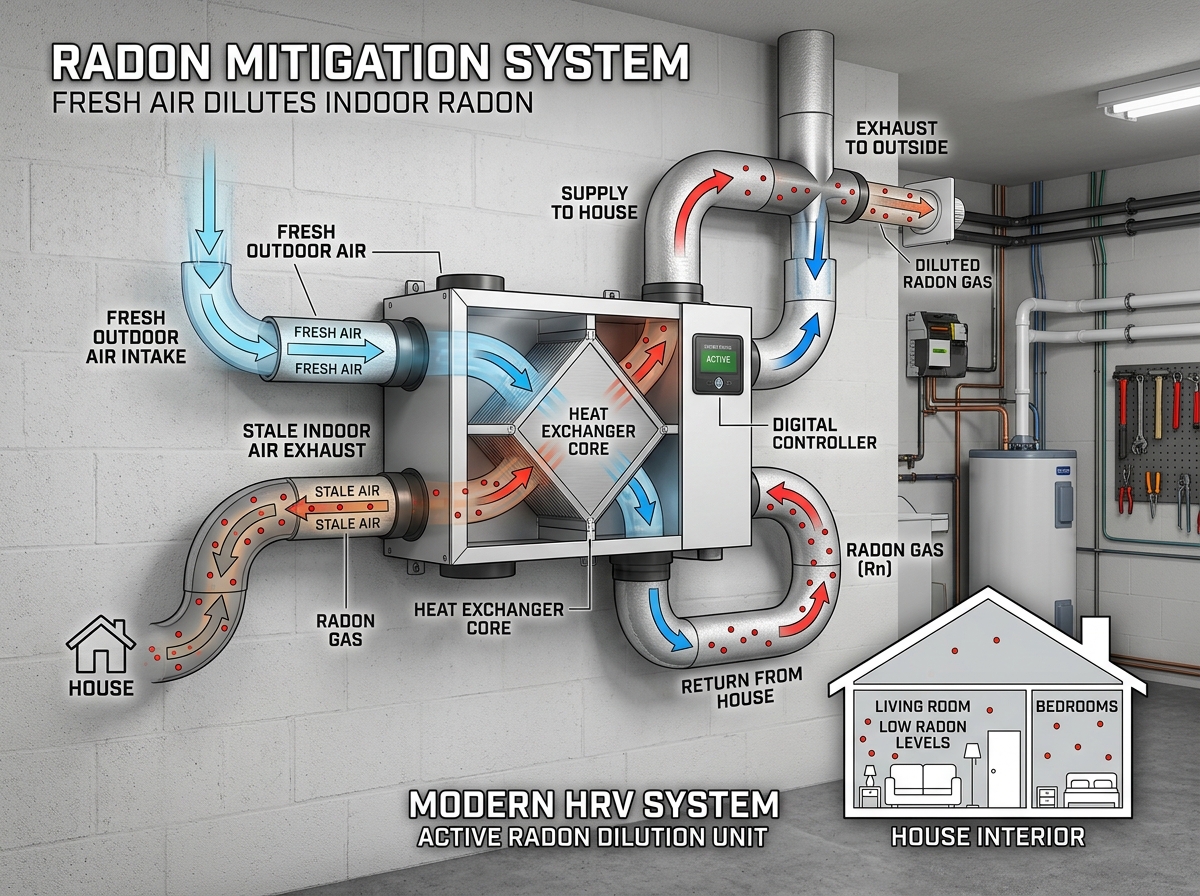
How HRVs Work: Continuous Fresh Air Exchange
An HRV is designed to exhaust stale, moist indoor air from your home and replace it with fresh, filtered air from outdoors. To save energy, it transfers heat from the outgoing stream to pre-warm the incoming fresh air.
By continuously diluting stale indoor air with clean outdoor air, an HRV lowers the concentration of airborne contaminants, including moisture, carbon dioxide, and radon gas.

Dilution vs. Active Sub-Slab Depressurization
While an HRV dilutes radon after it has already entered your home, it does not stop the entry process itself. If soil gas entry rates are high, dilution alone will rarely reduce radon below safe thresholds.
In contrast, an active sub-slab depressurization system uses a dedicated suction fan to create a continuous negative pressure zone directly beneath your foundation concrete slab, venting radon outdoors before it can enter.
When Is Mechanical Ventilation Enough?
Using an HRV to control radon is generally only appropriate in marginal cases—for example, if your long-term testing indicates levels between 200 Bq/m³ and 250 Bq/m³, and a balanced, fully operational HRV can achieve a 25% to 50% dilution reduction.
If your initial test reads above 250 Bq/m³, relying on an HRV is insufficient. You should install a dedicated sub-slab depressurization system.
To understand the full environmental picture of your home's air quality—including radon, fresh air circulation, and chemical pollutants—we recommend requesting a professional Indoor Air Quality Report. This full diagnostics audit detects complex ventilation flaws and measures volatile organic compounds (VOCs) to design a complete health blueprint.
Optimizing Your Air Exchanger and HRV Balancing
If you use an HRV, it must be properly balanced by a certified HVAC technician. An unbalanced HRV that extracts more air than it supplies will create negative pressure in your basement, actively sucking more soil-borne radon inside.
HRV Best Practices:
• Clean filters every 3 months to prevent air flow restrictions.
• Clean the exterior hood vents of leaves, ice, and insect screens.
• Verify balance annually to prevent basement depressurization.
These balance requirements align directly with global safety standards compiled in the official WHO Handbook on Indoor Radon ↗, which outlines pressure offsets and mechanical air circulation strategies for effective home health management.
References:
World Health Organization (2009). WHO Handbook on Indoor Radon: A Public Health Perspective. WHO Press.
Natural Resources Canada (2022). Heat Recovery Ventilators (HRVs) and Indoor Air Quality Standards. Government of Canada.
ASHRAE (2023). Standard 62.2: Ventilation and Acceptable Indoor Air Quality in Residential Buildings. American Society of Heating, Refrigerating and Air-Conditioning Engineers.