
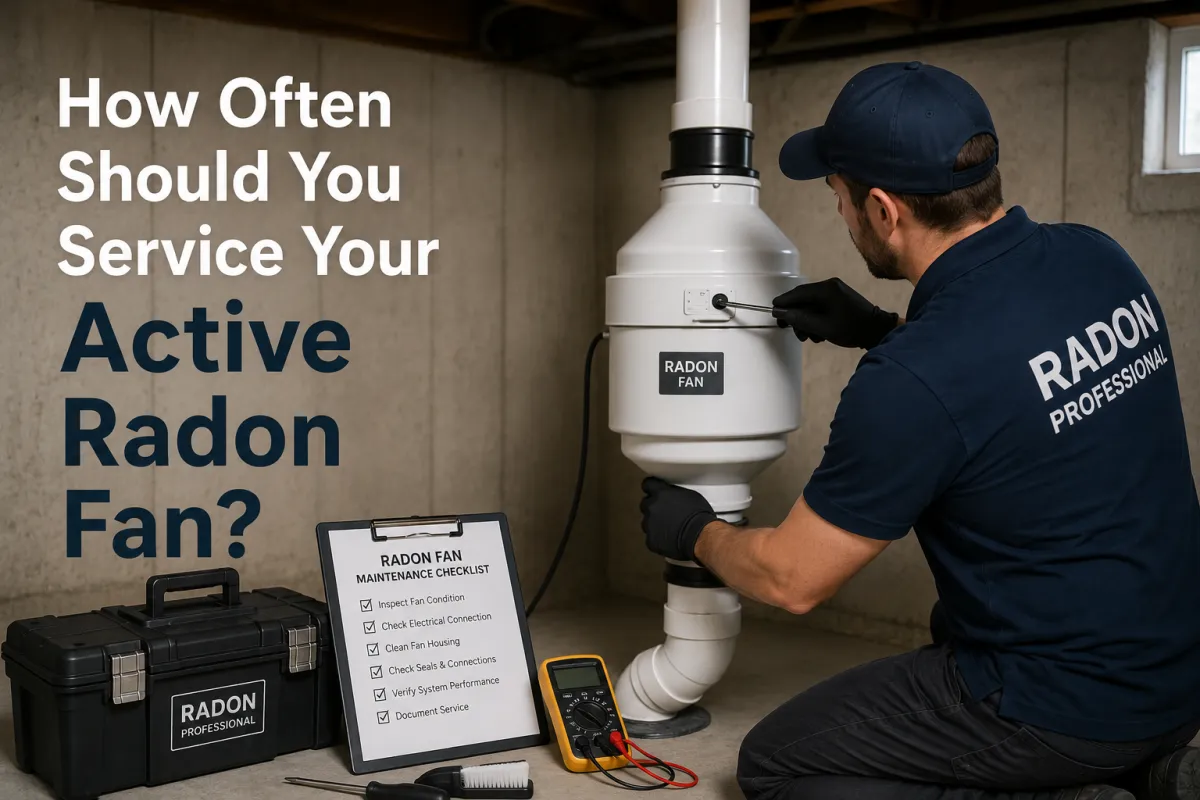
How Often Should You Service Your Active Radon Fan?
Introduction:
Active radon mitigation systems are exceptionally reliable, with high-quality inline fans engineered to run continuously for up to 15 years. However, regular annual maintenance checkups are essential to ensure your system continues to protect your home.
Why Radon Fan Maintenance Matters
Your radon fan runs 24 hours a day, 365 days a year, maintaining a negative pressure zone beneath your foundation slab. Over time, seasonal debris, extreme temperatures, and moisture condensation can affect its efficiency and lifespan.
Conducting simple annual checkups keeps the system operating at peak performance and helps prevent unexpected fan failures.

Checking Your U-Tube Manometer (The Pressure Indicator)
The primary diagnostic tool for homeowners is the liquid-filled U-tube manometer mounted on your basement extraction pipe.
If the liquid levels on both sides of the U-tube are equal (reading 0), the system has lost pressure, indicating that the fan is either turned off, has tripped a circuit, or has failed. If the levels are uneven, the fan is maintaining the necessary sub-slab suction.
Visual and Audio Diagnostics
Listen to the fan unit during operation. A healthy radon fan produces a quiet, steady hum. If you notice loud grinding noises, heavy rattling, or unusual vibrations, the fan's internal bearings may be worn out, requiring immediate professional replacement.
Additionally, check the exterior exhaust point annually to ensure it is free of leaves, bird nests, ice buildup, or insect screens.
Homeowner's Annual Service Checklist
Incorporate these simple diagnostic checks into your annual home maintenance schedule:
Annual Maintenance Routine:
Check the manometer weekly:Confirm that the liquid levels are uneven, indicating active pressure.
Inspect the foundation seals:Check for new concrete slab cracks and re-seal them immediately to preserve suction.
Clear exterior vents:Verify that the roofline exhaust remains free of leaves, snow, and nests.
Conduct a diagnostic test every 2 years:Deploy a short-term radon test to verify the system's continued effectiveness.
References:
Canadian General Standards Board (CGSB) (2021). CAN/CGSB-149.12-2021: Radon Mitigation in Existing Low-Rise Residential Buildings. Standards Council of Canada.
Association of American Radon Scientists and Technologists (AARST) (2023). System Maintenance, Manometer Verification, and Performance Audits for Residential Radon Reduction Systems.
Canadian National Radon Proficiency Program (C-NRPP) (2024). Homeowner Guide to Maintaining and Checking Sub-Slab Depressurization Systems.