
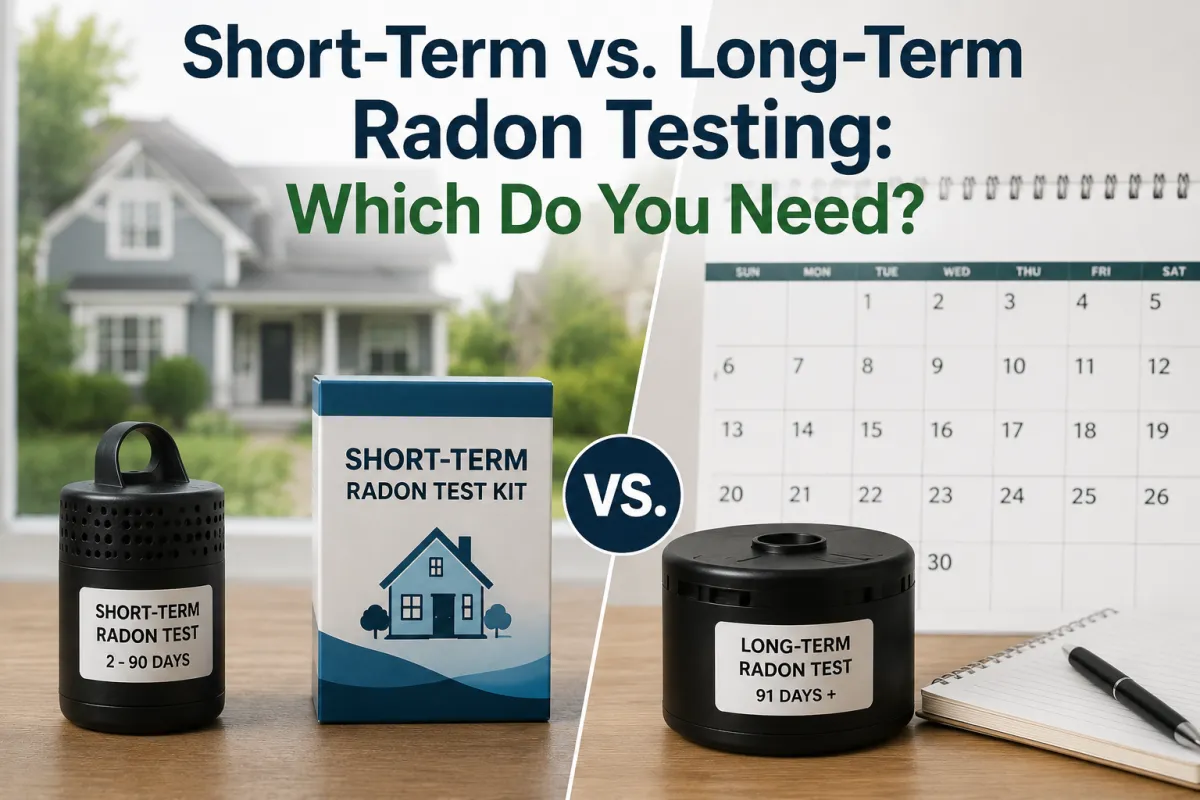
Short-Term vs. Long-Term Radon Testing: Which Do You Need?
Introduction:
When deciding to test your home for radon, you will encounter two distinct diagnostic methodologies: short-term screening and long-term testing. Choosing the correct test is essential for obtaining accurate, actionable data that protects your household.
Short-Term Screening (3 to 7 Days)
Short-term kits typically use activated charcoal canisters or liquid scintillation vials to absorb radon gas over a 3-to-7-day window. These tests act as a rapid diagnostic screen.
Because indoor radon levels fluctuate wildly from day to day based on barometric pressure, wind speed, and indoor heating schedules, a short-term test only provides a temporary snapshot. It cannot be used to justify expensive mitigation decisions on its own.

Long-Term C-NRPP Standard Testing (90+ Days)
Long-term testing uses a passive alpha track detector deployed for at least 90 days. Inside the device, a special polymer film records microscopic structural damage from individual alpha particles.
Health Canada and the Canadian National Radon Proficiency Program (C-NRPP) designate this as the gold-standard testing method. By recording soil gas trends over a complete season, it filters out short-term spikes to deliver an accurate average of your true annual exposure.
Direct Feature Comparison

How to Choose the Right Test for Your Needs
If you are currently buying or selling an Ottawa home and have a short real estate closing schedule, a short-term test is your only option to establish an immediate contingency holdback.
However, for general occupancy health checks, you should always choose a 90-day winter test. It ensures your long-term medical safety decisions are based on accurate data.
References:
Health Canada (2023). Guide for Radon Measurements in Residential Dwellings. Environmental and Radiation Health Sciences Directorate.
Canadian National Radon Proficiency Program (C-NRPP) (2024). Consumer Guide to Radon Measurement Devices, Calibration, and Sensitivity Metrics.
U.S. Environmental Protection Agency (EPA) (2020). A Citizen's Guide to Radon: The Guide to Protecting Yourself and Your Family from Radon. EPA Air and Radiation Division.