
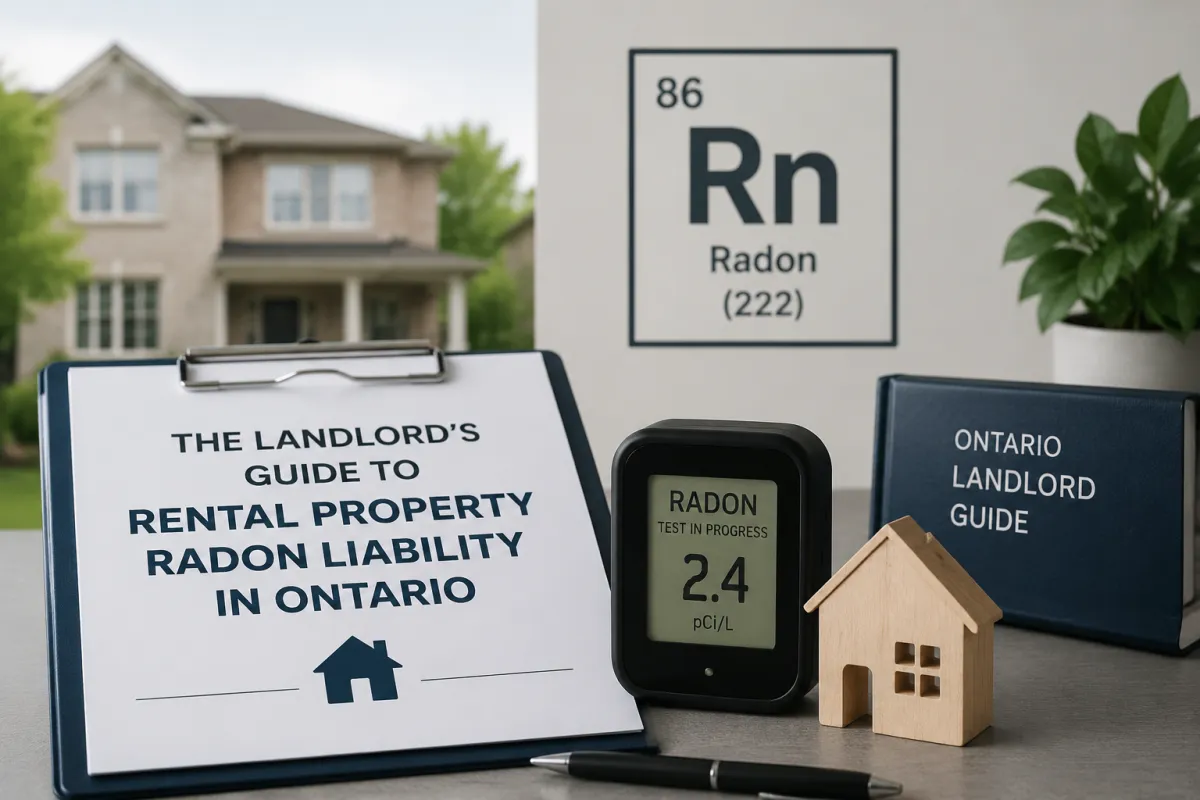
The Landlord's Guide to Rental Property Radon Liability in Ontario
Introduction:
In Ontario, the responsibilities of residential landlords extend far beyond general maintenance and fire alarms. As environmental awareness increases, property owners must understand rental property radon liabilities and their legal duty of care to provide bio-safe environments.
The Legal Duty of Care under Ontario Law
Ontario landlords are bound by a legal "Duty of Care" under both common law negligence principles and specific provincial statutes. Property operators are required to ensure that the premises are safe and free from biological or chemical hazards.
Because radon gas is a Class A human carcinogen and the leading cause of lung cancer in non-smokers, ignoring high radon levels in a rented unit constitutes a serious breach of this safety duty.

The Residential Tenancies Act (RTA) and Radon
Section 20 of the Ontario Residential Tenancies Act mandates that landlords are responsible for providing and maintaining a residential complex in a good state of repair and fit for habitation.
UnderLandlord and Tenant Board (LTB)rulings, indoor environments with radon concentrations exceeding Health Canada's guideline of 200 Bq/m³ have been deemed unfit for habitation. Tenants can seek rent abatement or order the landlord to install a certified mitigation system at their own cost.
Proactive Risk Mitigation and Liability Protection
The most effective protection against litigation is proactive testing and professional mitigation. If a landlord has a professional, C-NRPP certified test report showing safe radon levels, they are completely insulated from claims of negligence.
If levels exceed 200 Bq/m³, installing an active sub-slab depressurization system immediately resolves the hazard, protecting both tenant safety and property values.
Landlord Radon Compliance Checklist
Follow this structured 4-step checklist to ensure your rental units remain compliant, safe, and protected against litigation:
Landlord Liability Safety Rules:
Conduct winter testing: Place a 90-day C-NRPP long-term test canister in the lowest occupied level of all ground-facing rental units.
Provide tenants with results: Keep communication transparent to maintain tenant trust and satisfy RTA disclosure norms.
Retain certified documentation: Store testing certificates in your compliance files to support building valuations during sales.
Mitigate immediately if high: Engage a certified C-NRPP active mitigation specialist if levels exceed 200 Bq/m³.
Reference:
Government of Ontario (2006). Residential Tenancies Act, S.O. 2006, c. 17, Section 20 (Landlord's Duty of Habitability and Repair).
Ontario Landlord and Tenant Board (2024). Interpretation Guidelines on Environmental Hazards, Safety Standards, and Habitability Rulings.
Canadian Environmental Law Association (CELA) (2021). Tenant Safety and Radon in Rental Housing: Legal Duties of Ontario Landlords and Property Operators.