
Why Ottawa Basements Face Higher Winter Radon Risks ?
Introduction:
When winter arrives in Ottawa, it brings more than just sub-zero temperatures and heavy snow—it triggers a dramatic shift in how radon gas enters our homes. During the cold months, Ottawa basements experience their highest radon concentrations of the entire year due to physical pressure forces.
The Stack Effect: Ottawa's Invisible Vacuum
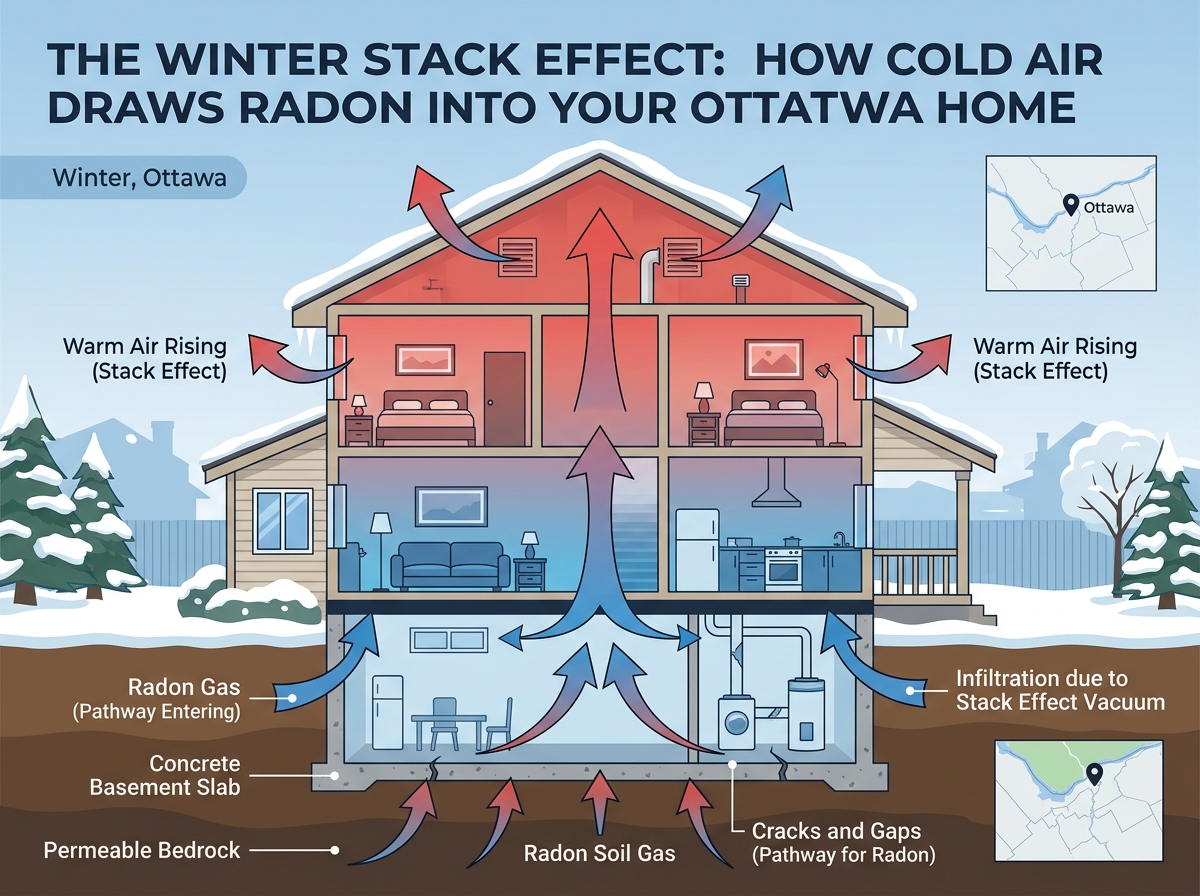
In the winter, we seal our doors and turn up our central heating systems. Warm air naturally rises up through the upper levels of the house, creating a strong vertical thermal updraft. As this warm air seeks release near the roof, it generates low air pressure at the basement level.
This vacuum-like difference in pressure draws soil vapors up through basement slabs, creating a continuous soil gas draw. Because the home acts like a chimney, winter is the period when radon concentrations are highest.

How Sub-Zero Soils Cap the Soil Capillaries
As Ottawa's soils freeze down to three feet deep, a thick, impermeable frost cap forms over the ground surrounding your house. Radon gas rising from bedrock cannot escape into the atmosphere outside.
Blocked by the frost cap, radon finds the only unfrozen point available: the warm, porous soil directly beneath your home's foundation slab. The gas travels under the frost layer and vents into your living spaces.
Heating Systems and Mechanical Ventilation
Mechanical appliances like exhaust fans, range hoods, and central dryers actively pump air outside, compounding indoor negative pressure. Unbalanced central combustion systems draw basement soil gases inside through any microscopic entry point.
Without fresh makeup air, the natural exchange rate drops, trapping radioactive decay products inside the living zone.
Practical Winter Prevention & Guidelines
Because winter conditions represent a worst-case scenario for radon exposure, Health Canada recommends conducting your primary radon test during the winter heating season (from October to April).
Your Winter Safety Checklist:
Run long-term alpha-track tests: Deploy a testing canister for at least 90 winter days to capture the season's true average.
Seal concrete expansion joints: Use polyurethane caulking to fill horizontal floor gaps and prevent gas draw.
Check your HRV settings: Ensure your Heat Recovery Ventilator is running and balanced to normalize indoor pressures.
These seasonal recommendations align directly with federal safety guidelines. Homeowners can review the complete official policy on the Health Canada Radon Guideline Page ↗. For detailed local risk assessments and geological statistics, you can also cross-reference the Canada Radon Map & Datalab ↗.
References:
Health Canada (2021). Cross-Canada Survey of Radon Concentrations in Homes. Radiation Protection Bureau, Environmental and Radiation Health Sciences Directorate.
Take Action on Radon (2024). Radon in Ottawa: Municipal Level Geotechnical Report & Exceedance Mapping.
World Health Organization (2009). WHO Handbook on Indoor Radon: A Public Health Perspective. WHO Press.
Canadian National Radon Proficiency Program (C-NRPP) (2023). Guide to Radon Mitigation Standards for Residential Buildings in Canada.